
Manage Account Links
Learn how to enable your merchants to go through Groov's journey (white labeled with your brand) and connect their accounts and access their funding eligibility or view their funding account details if already funded
You can use our test/sandbox Account Links to run test journeys either
- whilst your account is being activated (toggled to Live state) (OR)
- whilst in a Live state, you want to test any part of your customer/merchant journey (remember to toggle the Test switch to move to a Test/Sandbox mode)
Connect with your customers/merchants
You have multiple options to provide your customers/merchants a connected-unified experience via the Hosted journeys, whether its inviting them to onboard for the 1st time or enabling them to return back to access their accounts (just like a web-app Portal account).
Create a static Account Link
Use Cases - when this comes handy
- a link that can embed behind a CTA (Call To Action) on your website or mobile app or social channel that seamlessly brings your customers/merchants to the journey
- you want to run a mass outbound campaign to a segment list of your merchants using your Marketing/CRM application or your field/telephony teams via any channel: emails, sms/whatsapp, chat interfaces
- Generate a one-off static link using the 'Generate Static Account Link' CTA button from the Account Links dashboard menubar option. A snapshot below shows how it looks.

- As this is a static one-off link, you will provide Groov with a static reference value (e.g: WebsiteLeads) that helps you/team to identify leads/customers origination source.
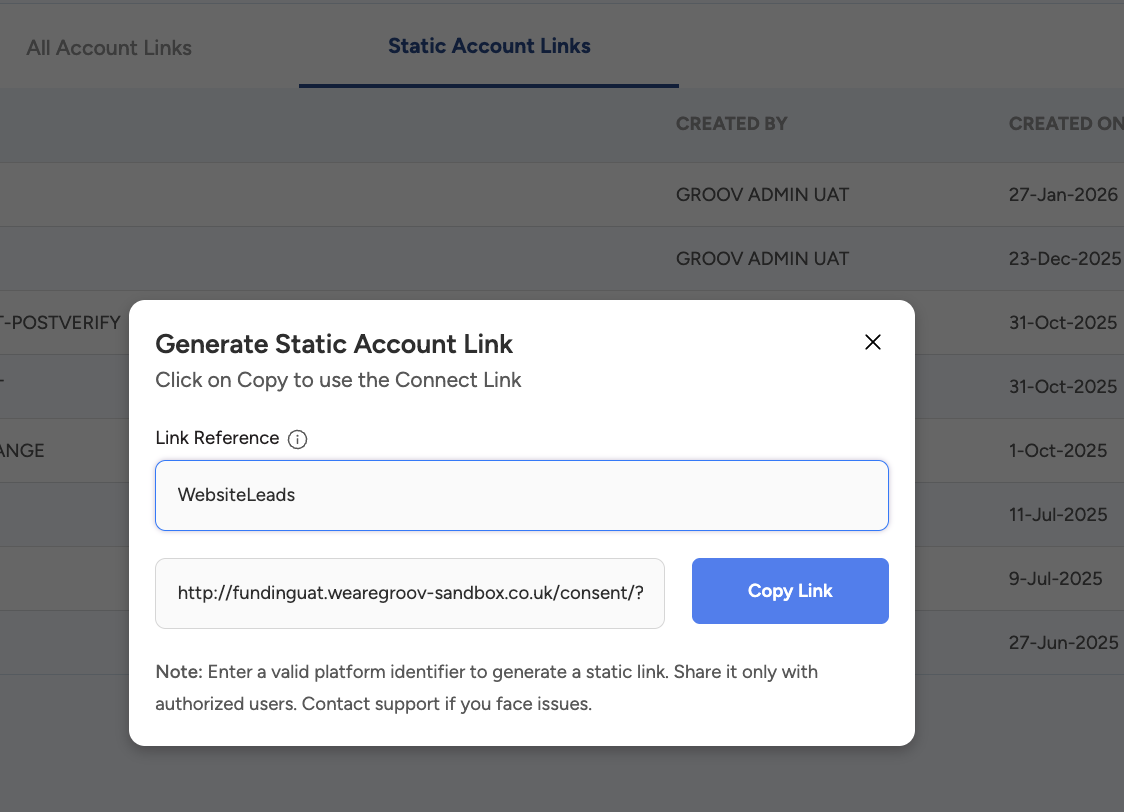
If you want to send a bespoke customer/merchant tagged link, please refer to the customer tagged standard link creation section.
- Once the link is available, you can copy the link using the Copy Link CTA and use it to drive your use case based journeys as appropriate.
Create a Customer tagged Account Link
Use Cases - when this comes handy
- you want to track a lead/account in your in-house CRM/ERP/Other Application with the data/information captured on Groov platform (lets say using your CRM's Lead Id or Account Number)
- for Payment Providers, you want to track and report by Merchant IDs (MIDs)
- For Financial Account Providers, you want to track and report end to end by CINs (Customer Identification Numbers or Customer Numbers)
- Generate a customer tagged account link using the 'Generate a Account Link' CTA button from the Account Links dashboard menubar option (it works from either the 'My Account Links' or 'All Account Links' list view). A snapshot below shows how it looks.

- As this is a bespoke customer tagged link, you will provide Groov with a customer reference name/identifier from your internal CRM/ERP/Application (e.g: Joe Bloggs or MY-CRM-REF010) that helps you/team identify the tagged customer.
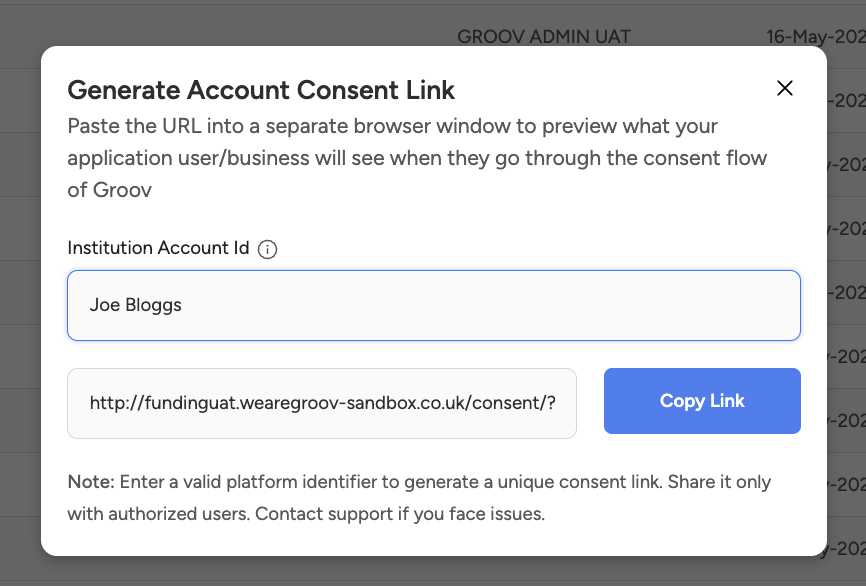
- Once the link is available, you can copy the link using the Copy Link CTA and use it to drive your use case based journeys as appropriate.
Manage Account Link
You and your team will be able to see all the Account Links generated across your platform as follows under Portfolio - Account Links leftmost menu bar section of the Groov Portal dashboard:
- The All Account Links view tab will show all the Account Links generated by anyone in your team using Groov Portal. The list will show the user who has generated the link, the date on which the link was created and will provide an option to view + copy the link
- The My Account Link view tab will show only the Account Links generated by you (i.e a named user on the Groov Portal account for your platform).
- The Static Account Links tab will show only the static account links generated by the account administrators (i.e a named user on the Groov Portal account for your platform).
Only Administrator Role tagged users are allowed to generate and view static Account Links.
Add UTM tags to your Account Links
UTM tags (also called UTM parameters or UTM codes) are short tracking values added to the end of a URL/link. They help you do UTM tracking by telling analytics tools where a visitor came from (source), how they arrived (medium), and which campaign drove the click (campaign).
You and your team will be able to add UTMs to any Account Links. You can use the instructions provided below to add UTMs to the links you generate on Groov platform or you can request Groov team to generate one for you and save it against the Account Links list in your Portal.
How to add UTMs to Groov Account Links?
- Copy the Account Links as detailed in one of the previous sections
- Use the tags described in the How does it look like section below and for every tag you wish to add, suffix to the end of the Account URL using &tagName
- You can add one or more UTM tags as per what you would wish to track using data on Groov platform, its your choice completely
- If you use leadSource to tag your partner organisation, then you will have to mandatorily use the related tag introducerName to state the name else name will show blank
How does it look like?
An example of a URL link enriched with utm parameters (using a Groov Account Link as example) looks like this:
In this URL, the utm tags i,e the fields prefixed with utm and the 2 additional tags leadSource and introducerName have to be exactly the way they are tagged/labelled, the accompanying values can be defined by you (other than anything specific if detailed below)
leadSource: Introducer or Referral partner as a source. If you have partners/sub-brokers/sub-ISOs you work with who deal with your customers directly and you would want to add an additional layer of trust by displaying your partner name to customers on the landing page, use this. (Only one value is supported for this tag i.e Partner )
introducerName: The name of the partner who the customer relates to instantly
utmSource: The source of the traffic (e.g., "google", "facebook", "email", "website").
utmMedium: The medium used to drive traffic (e.g., "cpc", "social", "email").
utmCampaign: this helps you know exactly what campaign generated the traffic. Make sure you differentiate them well to track their unique performances. (e.g., "cashflow-support-for-christmas", "new-product-launch").
utmTerm: Keywords used in paid campaigns. In case of paid search and/or referral, add “term” to better identify your performing keywords.
utmContent: If you have multiple links, or the same link included multiple times in your campaign, fill in this value to differentiate them. Example: logolink, CTAlink, headerlink, etc.
Updated 5 months ago